Privacy & cookies

 Dominic Fischer | June 2026
Multilingual visitor information doesn’t have to be complicated. Find out which languages are really relevant.

English isn’t always enough – but not every local authority needs ten languages either. The key factor is which visitors you actually want to reach and how multilingual content can be kept up to date in the long term.
Germany is an international tourist destination. In 2025, German accommodation providers recorded around 83.8 million overnight stays by guests from abroad. These accounted for 16.8 per cent of all overnight stays.
This raises a simple question for on-site visitor information: do these visitors actually understand the information we provide them with?
Space is limited on a traditional information board. Three or four complete language versions can quickly turn a clearly laid-out board into a wall of text. Digital visitor information opens up other possibilities here. However, the same principle applies digitally: more languages do not automatically mean better visitor information.
In many cases, this is a sensible starting point. However, whether English alone is sufficient depends very much on the destination. A border region attracts different visitor groups to a major city, whilst a wine-growing town attracts different visitors to a holiday region or an internationally renowned museum.
Therefore, before translating, the following should first be clarified:
Accommodation statistics, data from tourist information centres, website traffic figures or insights gained from interactions with guests can provide a good basis for this.
The aim should not simply be to offer as many languages as possible, but to use the right languages in the right places.

It is also worth prioritising content within a single offering.
Basic information on finding your way around, opening hours or how to use a service should be understandable to as many relevant visitors as possible. For detailed historical background texts or in-depth content, a different approach may be appropriate.
For example, a tourist attraction might offer a brief introduction in four languages, whilst extensive background information is initially available only in German and English.
Digital resources make this kind of tiered approach much easier to implement than printed materials.
At the same time, visitors can decide for themselves how deeply they wish to explore the subject: a short text for orientation, followed perhaps by an audio recording, historical images or additional background information.
This is precisely where analogue and digital visitor information can complement each other effectively.
On a sign, a name, a brief description and basic information are often sufficient. A QR code can then lead to further content in various languages.
This keeps the signage clear and concise, whilst ensuring that services for international visitors are not limited by the space available on the sign.
We have already looked at what is important when using such methods in the article ‘Using QR codes effectively in tourism’.
The advantage, therefore, does not lie in printing a sign that was previously bilingual in six languages in future. Rather, it lies in separating levels of information in a meaningful way.
Another mistake arises when existing German texts are translated into other languages without any changes.
A text may be linguistically correct yet still be difficult for international visitors to understand.
Local terms, administrative titles, historical contexts or figures well-known in the region may require further explanation. What is self-evident to locals is not necessarily so for a visitor from the Netherlands, France or the USA.
A simple example: the name of a historic building may not mean much to a visitor unfamiliar with the area at first. A brief note explaining why this building is important to the town can be more helpful than a word-for-word translation of a long German descriptive text.
Good multilingualism therefore also means viewing content from the perspective of the respective visitors.
Translation technologies have improved significantly in recent years. They can save a great deal of work, particularly when dealing with large volumes of tourism-related content.
This makes them a useful tool – but not automatically a complete editorial team.
Proper nouns, regional peculiarities, historical terms and tourism-specific phrasing should be checked. Editorial quality control is particularly worthwhile for key visitor information.
In practice, a two-stage process can therefore be useful:
First, the source text is written in such a way that it is clear, comprehensible and well-structured. This is followed by the translation, carried out with technical support, and a review of the language versions most important for the destination.
After all, even the best translation cannot salvage an unnecessarily complicated source text.
The real challenge often only begins after publication.
Opening hours change. Facilities close temporarily. Contact persons change. New services are added.
If each language version is maintained independently in different documents or on different webpages, discrepancies in the information can quickly arise.
When planning multilingual visitor information, the following should therefore be clarified at an early stage:
Particularly with more extensive offerings, centralised maintenance is often more important than the question of whether another language can be added at launch.
Web-based tours allow different language versions to be offered without visitors first having to install their own app. Visitors can start the tour directly at the location – for example, via a QR code.
We have examined the advantages and limitations of such solutions in more detail in the article ‘Digital city tours without an app: When web-based tours make sense’.
Multilingualism is not an end in itself. It becomes valuable when a visitor stands in front of a landmark and can actually understand the relevant history.
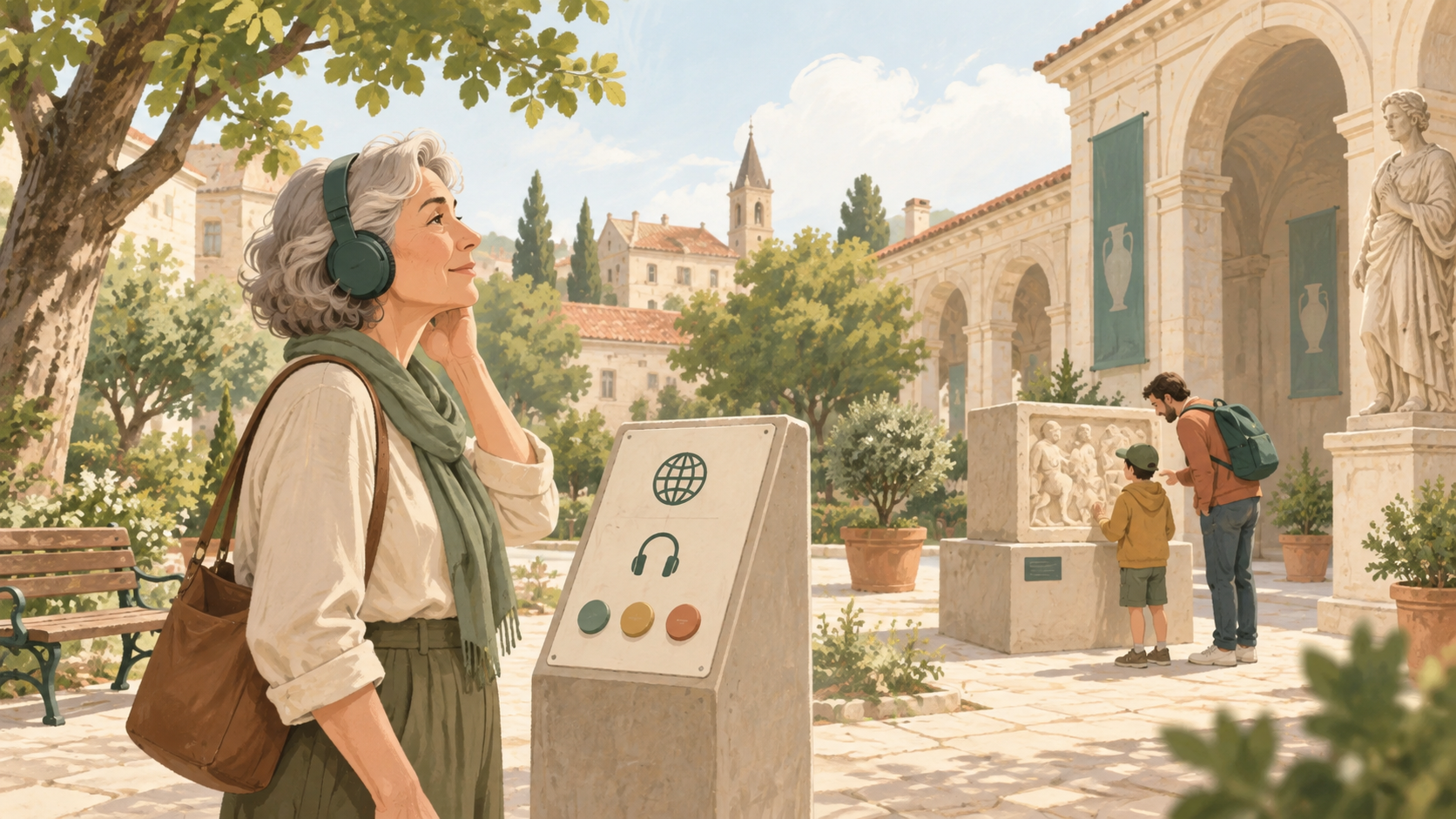
Multilingual visitor information doesn’t have to be a massive translation project.
A good place to start is to identify the key visitor groups, prioritise relevant information and, initially, break down language barriers where they actually arise.
Digital solutions provide additional scope for this. They can complement traditional signage, offer varying levels of detail and display content separately by language.
However, the visitor’s perspective remains crucial here too:
What information do I need in this place – and can I understand it?
Anyone who can answer this question is already a big step closer to providing good multilingual visitor information.