
Privacy & cookies
 Dominic Fischer | June 2026
A QR code does not in itself constitute digital visitor information: 9 mistakes local authorities should avoid
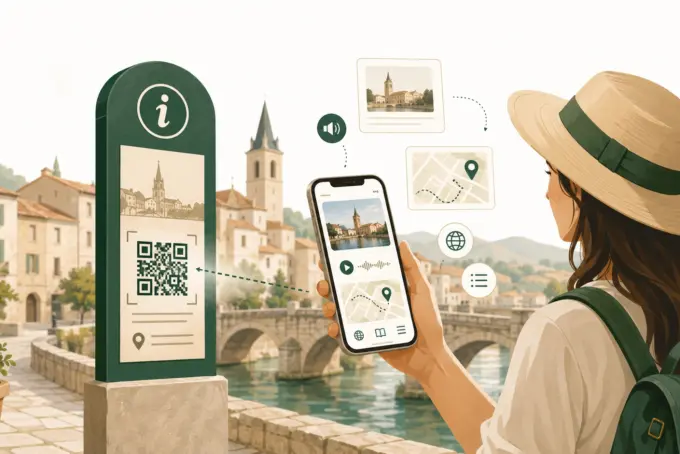
Nowadays, QR codes are almost a given when it comes to tourist visitor information. They can be found on information boards, at places of interest, in museums, on city maps or along walking trails. A single scan is all it takes for visitors to access additional text, images, audio or up-to-date information on their smartphones. It is precisely at this point that traditional visitor guidance systems are increasingly reaching their limits.
In practice, QR codes still often lead to generic websites, cluttered PDF files or pages that are barely usable on a smartphone. Sometimes the link no longer works. Sometimes it simply remains unclear what visitors can expect after scanning.
The technology is rarely the problem here. The crucial question is: what information does the visitor need at this exact location and at this exact moment?
Anyone wishing to use QR codes effectively in tourism should avoid the following mistakes.
A QR code with the prompt ‘Scan now’ does not provide a compelling reason to take out your smartphone. Visitors want to know what to expect.
Instead of ‘More information’, specific prompts are helpful:
The QR code is merely the gateway. What matters is the recognisable added value behind it.
Even technically flawless code will not be used if it is too small, too high up or poorly lit. Reflective surfaces, unfavourable angles and a lack of space to stand make scanning even more difficult.
QR codes at tourist attractions and in public spaces should be clearly visible, high-contrast and scannable from a comfortable distance. It is important to test them at the actual location. A printout in the office gives little indication of how the code will work later on in sunlight, rain or in the shade.

If a visitor is standing in front of a tourist attraction, the QR code should take them straight to the relevant content. Anyone who, after scanning the code, has to navigate through the local authority’s website and search for the building will quickly lose interest.
The same applies to a city tour via QR code. The link should take visitors straight to the correct stop or the tour of their choice. The more intermediate steps required, the higher the drop-out rate.
QR codes are almost always scanned using a smartphone. Nevertheless, they still frequently link to multi-page PDFs, long blocks of text or pages with small font sizes and menus that are difficult to navigate.
Digital visitor information must work whilst on the move. Visitors are often outdoors, holding their smartphone in one hand, and want to access information quickly.
The following are therefore suitable:
A mobile-optimised landing page is not just an extra feature, but the foundation for the effective use of QR codes in tourism.
A QR code promises quick access. However, if it leads to an app store, this creates a new hurdle. Downloading, installation, permissions and registration are too much of a hassle for many visitors on a one-off visit.
Web-based digital city tours and visitor information can be opened directly in the browser. They work regardless of the smartphone model and are particularly suitable for spontaneous use.
Tourism apps can be useful for extensive or regularly used services. However, for information about a single attraction, access without an app is often the better solution.
As digital pages theoretically offer unlimited space, existing brochure texts are often reproduced in full. The result is lengthy content that hardly anyone reads at the site.
At the same time, a single sentence is usually not enough to offer any added value compared to the information board.
It makes sense to provide different levels of detail: a brief introduction conveys the most important points. Interested visitors can then access images, audio clips, background information or further points of interest.
The location also determines the content. At a historic monument, the focus is on history. At a viewpoint, the landscape and visible landmarks are of interest. In the city centre, restaurants, shops and events may be relevant.
Not every QR code in public spaces appears trustworthy. Codes can be damaged, covered up or tampered with.
Local authorities and tourist organisations should therefore clearly indicate who is behind the service. An official logo, a brief explanation and a verifiable web address help to instil confidence. Phrases such as ‘Official visitor information from the town’ can also be helpful.
The codes should be checked regularly on site. This is particularly important in the case of freely accessible signs and stickers.
QR codes make it possible to provide content in several languages without having to print every translation on a sign. This advantage is still underutilised.
Which languages are appropriate depends on the destination and its source markets. Not every local authority needs ten full translations. It is important to prioritise sensibly.
Digital accessibility should also be taken into account from the outset. This includes easily legible font sizes, sufficient contrast, clear texts, alternative text for images, and subtitles or transcripts for audio content.
In this way, digital visitor information can reach significantly more people than a traditional sign.
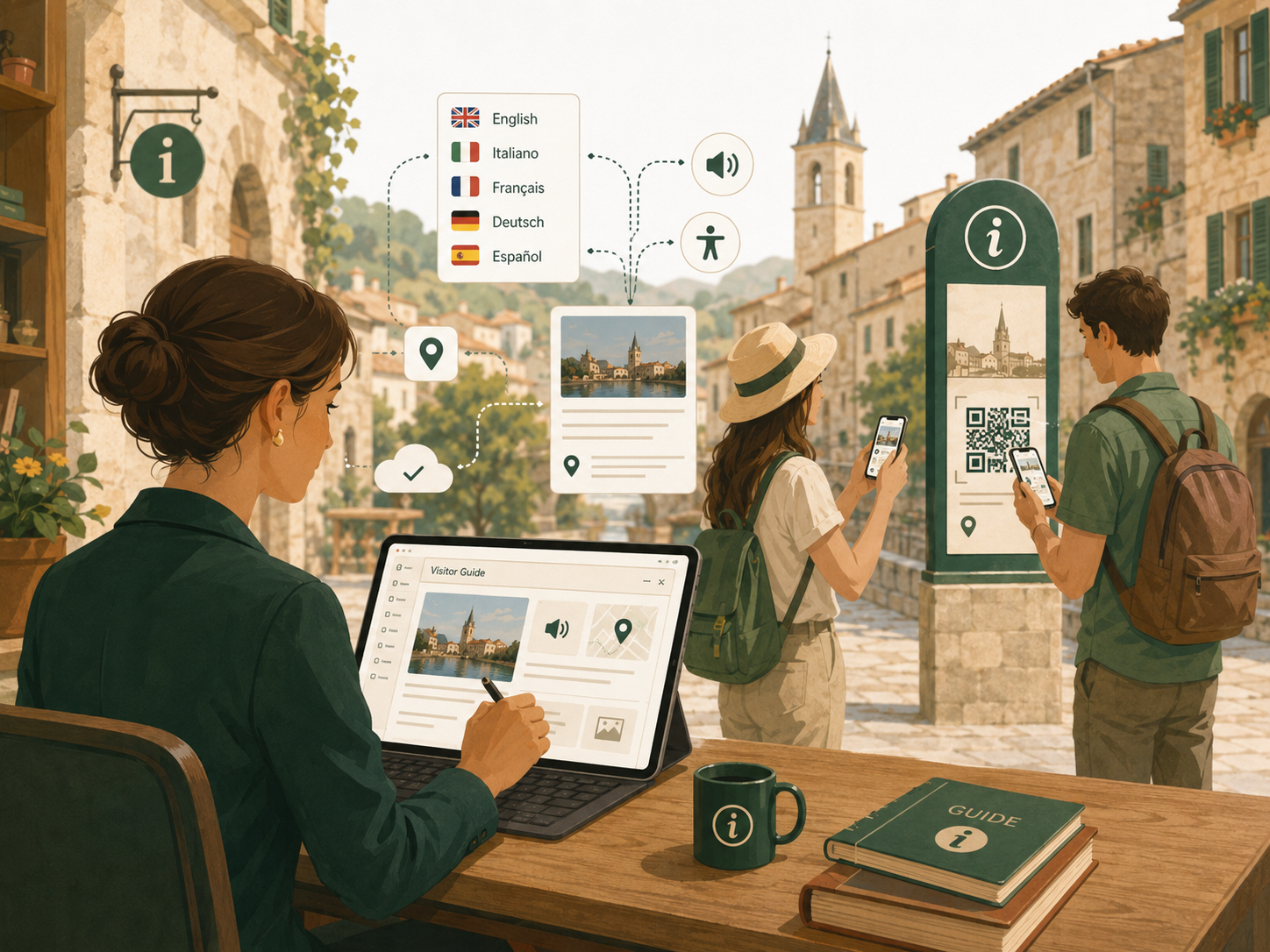
The QR code has been added and the page published. This often marks the project as complete. However, opening hours change, events come to an end and linked content is moved.
Before launching the project, the following should therefore be clarified:
Systems that allow changes to be made without the need for an agency or the local authority’s IT department are particularly practical. Ongoing maintenance forms part of the project from the outset.
QR codes are neither a digital strategy nor a short-term gimmick. When used correctly, they link existing signage to up-to-date, multilingual and in-depth content.
They can supplement an information board with an audio clip, launch a digital city tour or highlight other places of interest in the surrounding area.
Key factors include a clear benefit, a suitable location, content optimised for mobile devices, direct access without unnecessary barriers, and reliable maintenance.
With the MAQNIFY Guide, QR codes on information boards, signposts, signs and printed materials can be linked directly to digital content. Visitors can access text, images, audio and guided tours in their smartphone’s browser – without having to install an app first.
The content is managed centrally, can be provided in multiple languages and updated at any time. This allows existing signage to be supplemented digitally without having to set up a completely new visitor guidance system.
Would you like to explore how QR codes could be used for your visitor information, your tourist attractions or a digital city tour? Please get in touch with us to discuss your specific use case.