Privacy & cookies

 Dominic Fischer | June 2026
The benefits of web-based virtual tours, their limitations, and what local authorities should bear in mind when planning them.
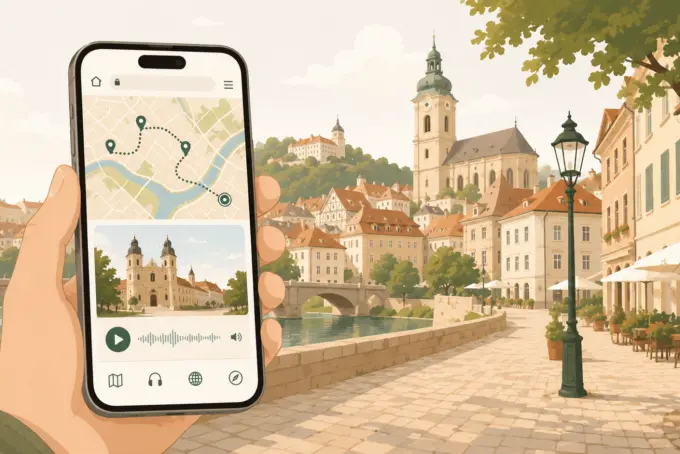
Exploring a city on the spur of the moment, stopping in front of a historic building and finding out more about it: digital tours can offer real added value in situations like these.
But how does the information get onto your smartphone? Do you need a dedicated app – or is a web-based solution that opens directly in your browser sufficient?
Both can be useful. The decisive factor is not so much the technology as the question of how, when and by whom the service is to be used.
On a web-based city tour, visitors access the content directly via their smartphone’s browser. They can start the tour, for example, by scanning a QR code on an information board, clicking a link on the tourist website or following a reference in a leaflet.
There is no need to download an app from an app store.
The tour itself can still be comprehensive: stops, maps, text, images, audio, videos and further information can all be linked together. How such digital city tours are structured generally depends heavily on the location and the desired user experience.
One advantage of web-based services is that they can be accessed straight away.
Tourist services are often used on the spur of the moment. Visitors might spot a sign for a walking tour whilst out and about, or take an interest in a place of interest they happen to be passing by.
If, between this initial interest and the actual content, there is first the need to visit the app store, download and install an app, this creates additional steps. A QR code that leads directly to a mobile page shortens this process.
However, that alone does not guarantee that the service will be used. A poorly placed QR code or a confusing mobile page remains a hurdle even without an app. Access, design and content must therefore be considered together.
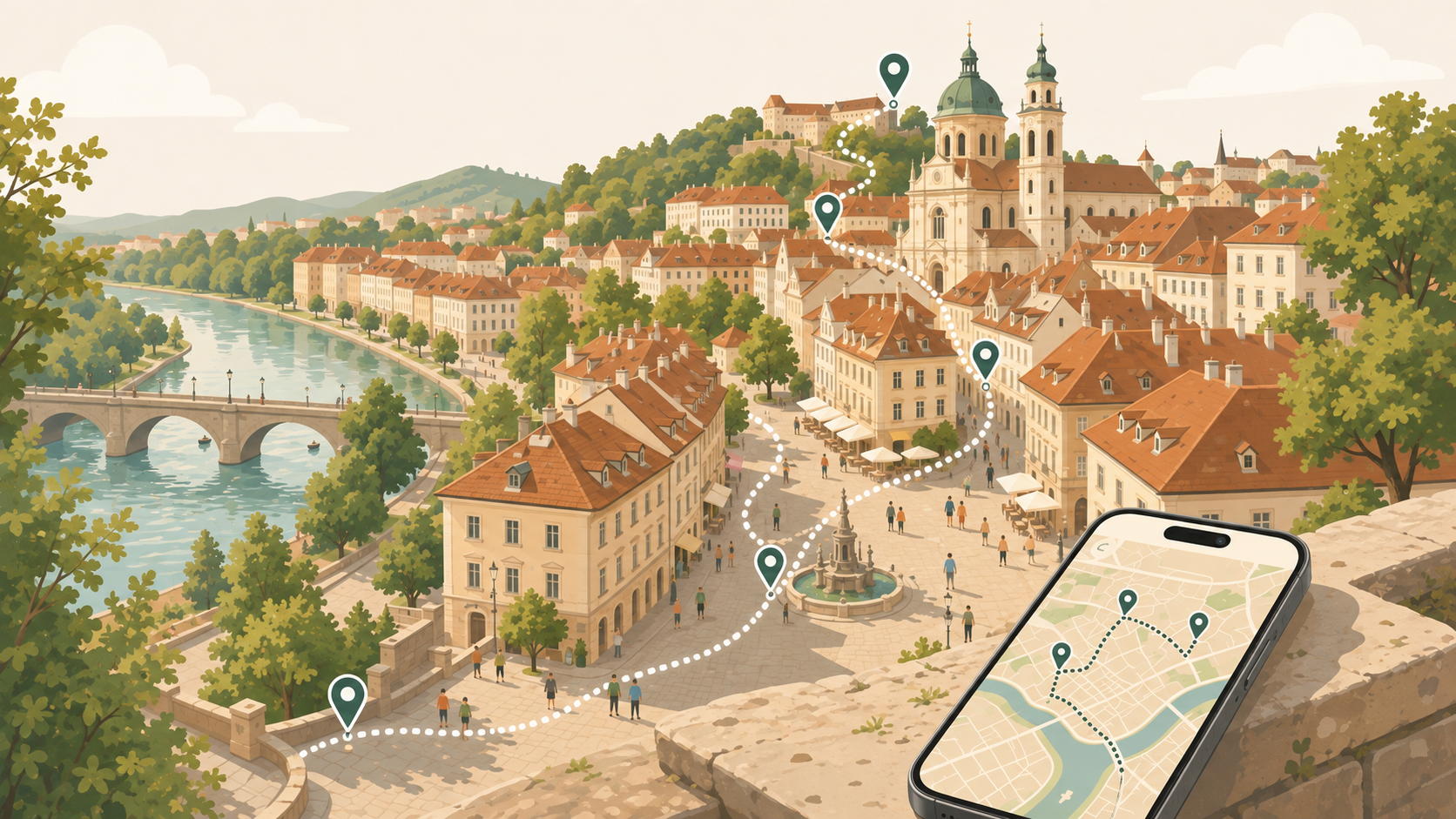
Digital city tours are often associated with as many technical features as possible: interactive maps, videos, audio, quiz functions or extensive background information.
However, not everything that is technically possible automatically improves the tour.
At a historical site, a short audio clip may be more interesting than a long text. At a viewpoint, a map might be more helpful. Elsewhere, a historical photograph accompanied by a few explanatory sentences may suffice.
Audio guides, in particular, can usefully supplement information, as visitors can look around their surroundings whilst listening to a story or explanation.
The more important question is therefore not: ‘What can we include?’, but rather: ‘What will actually be helpful to visitors at this stop?’
A common mistake is simply to convert existing content into a digital format.
A printed brochure then becomes a long mobile webpage. In terms of content, little has changed – only the medium is different.
However, digital visitor information offers other possibilities. Content can be tiered: a brief introduction for everyone, more in-depth information for those interested, audio for those who prefer to listen, and further tips for guests who want to discover even more.
In this way, the digital tour ties in with a fundamental trend in visitor information: analogue and digital offerings do not have to replace one another. They can fulfil different roles. We explored this in more detail in the article ‘Why traditional visitor guidance systems are no longer sufficient today’.
On a traditional information board, different language versions compete for limited space. With digital tours, however, content can be presented separately by language.
This does not automatically mean that every translation is necessary. The choice of languages should be based on the actual visitor groups.
The digital city tour in Breisach provides a clear example: the existing signage there was supplemented with QR codes, and the digital content was made available in several languages.
What is interesting here is not so much the specific technical solution as the principle: the analogue information remains clear and concise, whilst the digital format allows for greater depth of information.
A solution that doesn’t involve an app isn’t automatically the best choice for every project.
Web-based solutions often rely on a stable internet connection. Depending on the technical implementation, offline functions, push notifications or certain device-specific features may be more limited than with a native app.
The content itself also needs to be maintained. Out-of-date opening hours, broken links or outdated recommendations stand out just as negatively in a digital format as they would on an old information board.
And finally, a digital tour does not replace every other form of information provision. In-person city tours, printed materials, signage and digital information can cater to different target groups and situations.
A dedicated app can be useful if a service is used regularly, requires complex functions or goes far beyond a single tour.
Browser-based access, on the other hand, is particularly suitable when guests are expected to join spontaneously and use the service immediately on site.
The decision should therefore not start with the technology, but with a few simple questions:
Only then should a decision be made as to which technical solution is appropriate.
Whether it’s an app or a browser is ultimately a question of implementation.
What matters is that visitors can easily find the content, that the information is relevant to the situation at hand, and that the tour can be kept up to date even after the project has started.
Anyone wishing to compare different implementations will find further examples from local authorities and tourism organisations in the case studies on digital tours and guides.