Privacy & cookies

 Dominic Fischer | June 2026
Signage remains important – but is often no longer enough. Find out how local authorities are expanding their visitor information digitally and reaching visitors more effectively.
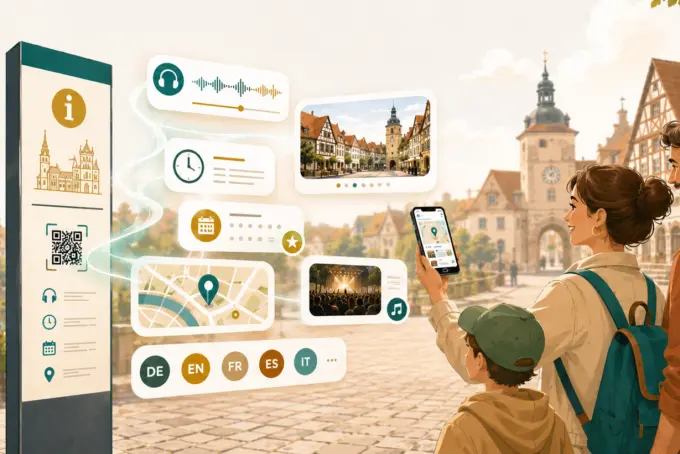
Signs, information boards and signposts have been a staple of tourist destinations for decades. They show the way, highlight places of interest and provide visitors with important information on the spot.In short: visitor guidance simply doesn’t work without signage.And yet, something crucial has changed in recent years. Today’s visitors no longer just want to know where something is. They want to understand what makes a place special. They want to learn about the background, check opening times, discover events, receive recommendations or access content in their own language.
It is precisely at this point that traditional visitor guidance systems are increasingly reaching their limits.
Physical signage remains important. It provides orientation, is visible in public spaces and gives visitors a sense of security. It is indispensable, particularly in city centres, on walking trails, at tourist attractions or at central arrival points.
But a sign is, after all, just a sign. It has a fixed size, a fixed location and fixed content. What is written on it is largely decided at the very moment it is produced.
This presents a number of challenges.
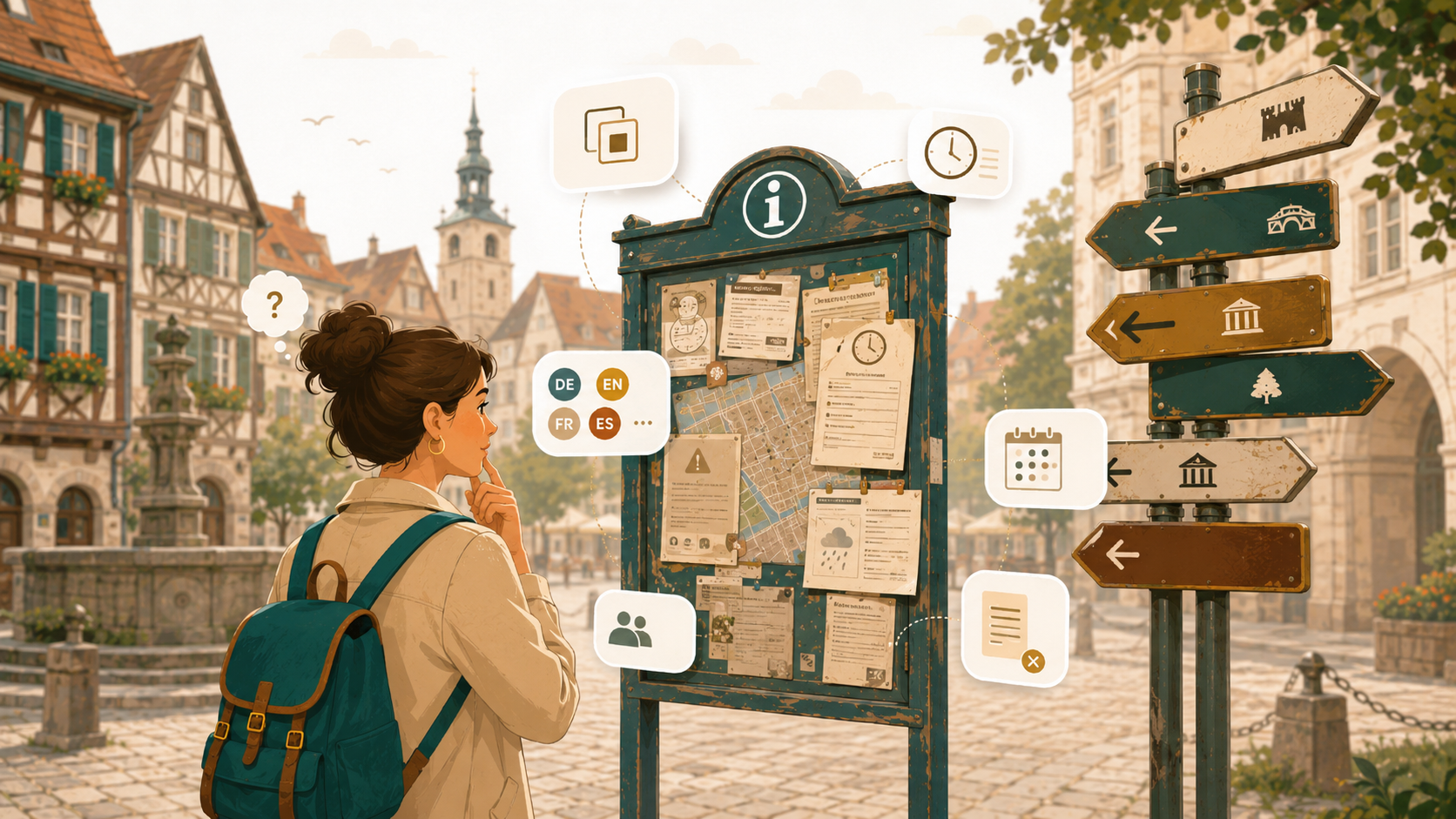
You can’t fit as much information as you’d like onto an information board. Texts usually have to be drastically shortened. There might just be enough space for a brief description. But when it comes to fascinating background stories, historical photos, audio clips, further tips or information in several languages, space quickly becomes tight.
Yet it is often precisely this additional content that brings a place to life.
A monument is not just a monument. A historic building is not just a pretty photo opportunity. An old town alleyway is not just a route from A to B. Many places only reveal their true charm once you know their history.
Traditional signage can provide a starting point for this. However, these days, people are increasingly turning to digital media to find out more.
Another problem is that content changes.
Opening hours are adjusted. New events are added. Guided tours are cancelled or rescheduled. Catering outlets change their menus. Contact details change. Projects continue to evolve.
What was up to date yesterday may already be out of date tomorrow.
With physical signs, every change involves a lot of effort: coordination, design, production, installation and additional costs. That is why out-of-date information often remains in public spaces for longer than is actually sensible.
This is frustrating for visitors. For local authorities and tourist organisations, it is inefficient.
Many places have long since ceased to cater solely to German-speaking visitors. International visitors expect information in a language they can understand – at the very least English, but often also Dutch, French or other languages.
This quickly leads to a dilemma with traditional information boards.
Either the texts become very long and the layout confusing, or the content is shortened so drastically that hardly anything sticks in the mind. For many local authorities, it makes no sense – either financially or in terms of design – to produce every sign in multiple languages.
Visitor behaviour has also changed. Many people no longer plan their visit entirely in advance. They decide what to do next whilst they’re out and about. They stop, scan a QR code, look for nearby recommendations or take inspiration from a brief suggestion.
So visitor information is no longer provided solely at fixed points. It happens in the moment.
What’s nearby right now? What’s worth doing with children? Is there an event on today? Which route suits the time I have available?
Rigid information systems can only answer such questions to a limited extent.
The important thing is: it is not a question of doing away with existing signage.
On the contrary.
The best solutions arise where physical and digital visitor information work together effectively. The sign remains the visible entry point in public spaces. It attracts attention, provides guidance and builds trust.
The digital extension then takes care of everything that cannot fit on the sign: more information, more languages, more up-to-date content and a richer experience.
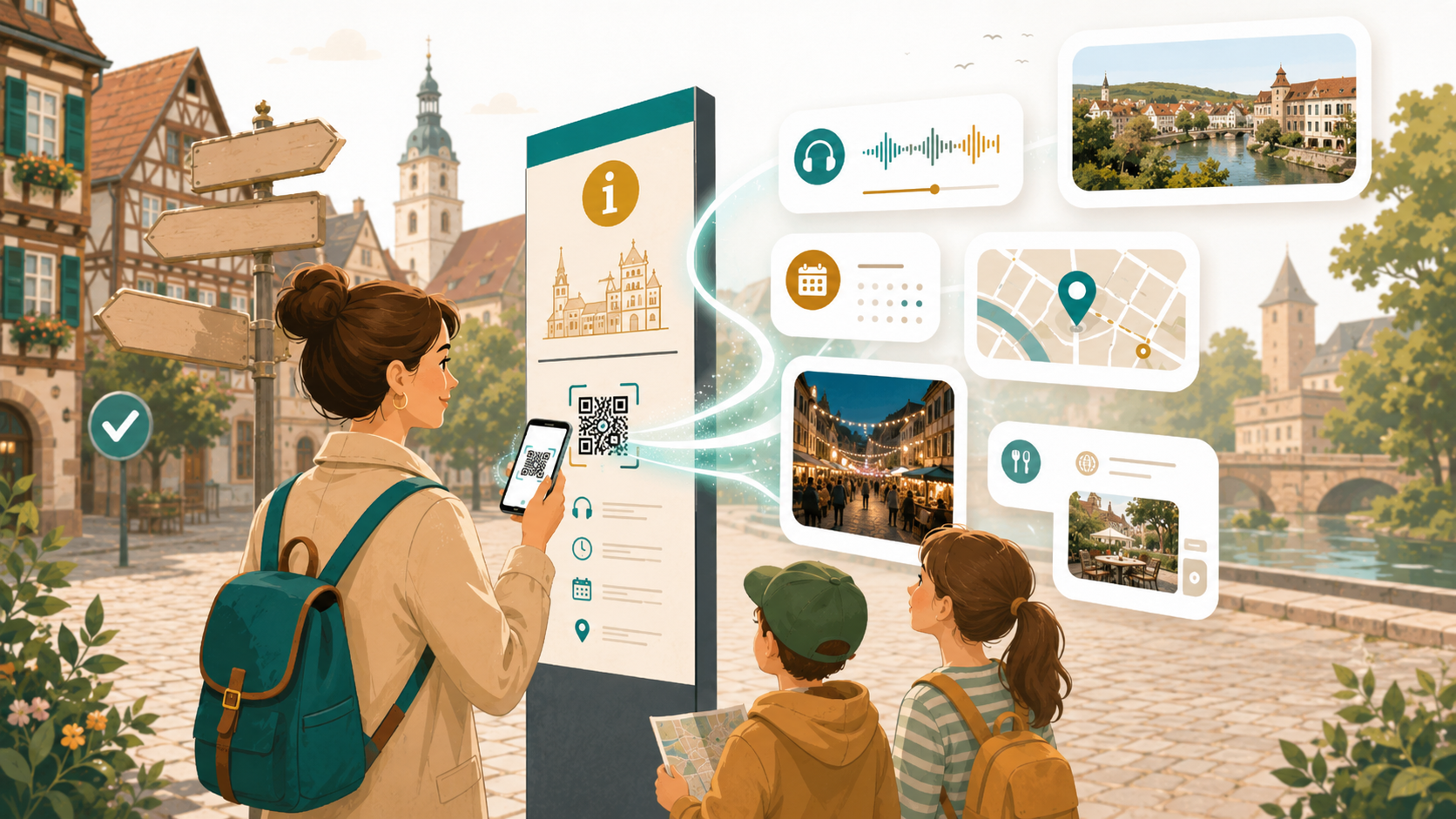
Using QR codes or short web links, visitors can access additional content right there on the spot. This can take many different forms: background information on the history of a place, audio clips, picture galleries, historical context, event tips, suggested routes or recommendations for things to do in the surrounding area.
The big advantage is that the content doesn’t have to be confined to the space on a sign. A brief note on site is enough. The actual story can be told digitally.
This changes the impact. Visitors don’t just read a piece of information; they delve deeper, understand the context and discover things they might otherwise have overlooked.
Many towns and local authorities are familiar with the problem: over time, the number of signs, noticeboards, posters and notices keeps growing. Something new is added for every new issue. Eventually, a confusing jumble of signs emerges.
This is neither attractive nor particularly helpful.
Digital solutions can help alleviate this problem. Not all information needs to be permanently displayed in public spaces. Much of the content can be made available centrally in digital form and updated as required.
Public spaces remain tidier. At the same time, visitors receive more information than before.
In the past, a visitor guidance system was often seen as a one-off project. It was planned, produced and installed – and was then, for the time being, complete.
Today, this approach only works to a limited extent.
Tourist information is constantly changing. New attractions emerge. Events come and go. Topics gain or lose importance. Visitors’ expectations are also evolving.
That is why visitor information is increasingly becoming an ongoing task. Digital systems help to organise this task more effectively. Content can be managed, updated and expanded centrally. This reduces the workload and ensures that visitors receive reliable information.
So the crucial question is not:
Signage or digitalisation?
The better question is:
How can the two systems work together most effectively?
Physical signage ensures visibility, wayfinding and a physical presence on site. Digital content provides up-to-date information, multilingual support and additional experiences.
It is only by combining the two that a visitor guidance system is created which truly meets today’s requirements.
Traditional visitor guidance systems remain a key component of modern visitor guidance. They are not going away. Their role is changing.
They become a point of entry. An invitation. A visible anchor in public spaces.
The real depth comes from digital enhancements.
Local authorities, regions and tourist organisations can thus enhance their existing infrastructure in the long term, provide information more flexibly and better reach international target groups.
Ultimately, it is not about using more technology. It is about giving visitors exactly the information they really need at any given moment.
And that is precisely what defines modern visitor information today.